





























Why Biometric Templates Are Not Photos
One of the most common misconceptions about facial recognition technology is that it stores a photograph of every person who uses it. In reality, modern facial recognition systems store a unique mathematical template — not an image. Here is what that actually means and why it matters.
What Does a Facial Recognition System Actually Store?
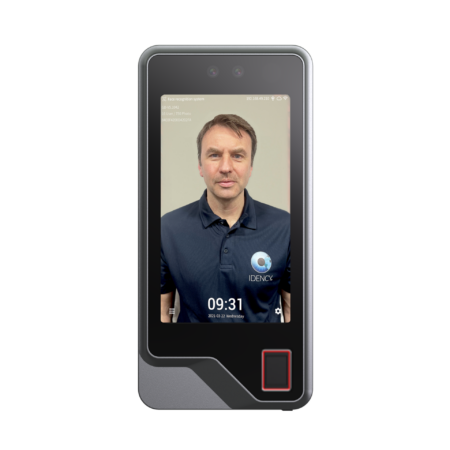
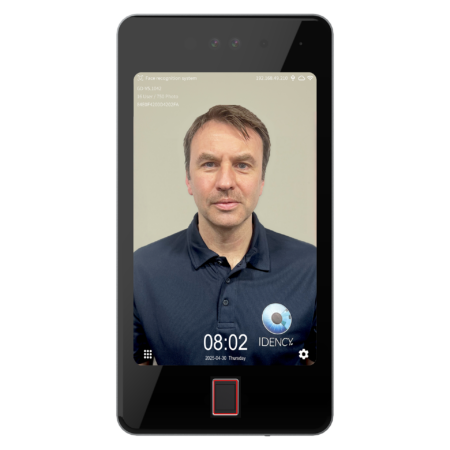
When a person enrols onto a facial recognition system, the camera captures an image of their face and identifies key facial characteristics. The system then converts these into a complex mathematical representation called a biometric template. The original image is discarded and only the encrypted template is kept.
The template itself contains no usable image data and cannot be viewed as a photograph.
A Biometric Template Is More Like a Password Than a Photo
A useful way to think about a biometric template is as a highly complex password generated from your facial features. Just as a website stores a secure password hash rather than your actual password, a facial recognition system stores a mathematical representation of your face rather than a picture of it.
When you present your face to the device, a new template is created and compared against the stored one. If they match within an acceptable tolerance, access is granted or the clocking event is recorded. At no point does the system need to display or retrieve a photograph.
Can a Face Be Recreated From a Biometric Template?
No. Modern biometric templates are designed as one-way mathematical representations. The data stored is sufficient to compare one template against another, but it cannot be used to reconstruct an image of the original face.
Even if someone gained access to a biometric template, they would not be able to generate a photograph of the individual from it. This is one of the key reasons why biometric templates are considered significantly more secure than many traditional forms of identification.
What Happens If a Database Is Breached?
If a database containing biometric templates were compromised, the attacker would not gain access to a library of photographs — only encrypted mathematical templates that have no visual meaning. Unlike photographs, these cannot be viewed or used to identify someone by sight.
Modern biometric systems also employ additional security measures including:
Why Businesses Choose Facial Recognition
Organisations increasingly adopt facial recognition because it offers both convenience and security. Unlike cards, PINs or passwords, facial recognition cannot easily be shared, borrowed or forgotten.
The Difference Between Photographs and Biometric Templates
| Photograph | Biometric Template |
|---|---|
| Can be viewed by humans | Cannot be viewed as an image |
| Contains visual information | Contains mathematical data only |
| Can identify someone by sight | Cannot identify someone visually |
| Can be copied and shared | Used only for biometric matching |
| May reveal personal appearance | Reveals no usable image |
Frequently Asked Questions
No. Modern facial recognition systems store an encrypted biometric template rather than a photograph of your face.
No. Biometric templates are one-way mathematical representations and cannot be converted back into a photograph.
Most modern biometric systems encrypt templates both while stored and while being transmitted between systems.
Yes. Under UK GDPR and EU GDPR, biometric templates used for identification purposes are considered personal data and should be protected accordingly.
In many respects yes. A biometric template contains no usable image of a person and cannot be visually inspected or reconstructed into a photograph.
To Summarise
Understanding this distinction helps dispel one of the most common myths around facial recognition and demonstrates why modern biometric systems can provide both strong security and robust privacy protection.
Organisations increasingly adopt facial recognition because it offers both convenience and security. Unlike cards, PINs or passwords, facial recognition cannot easily be shared, borrowed or forgotten.















 English (UK)
  English
  English (Canada)
  Français du Canada
  Svenska
  Português
  Nederlands
  Italiano
  Français
  Español
  Deutsch